CRAFT IS ART: SHAUN CRAWFORD FOR BARBOUR SOLWAY RE-LOVED
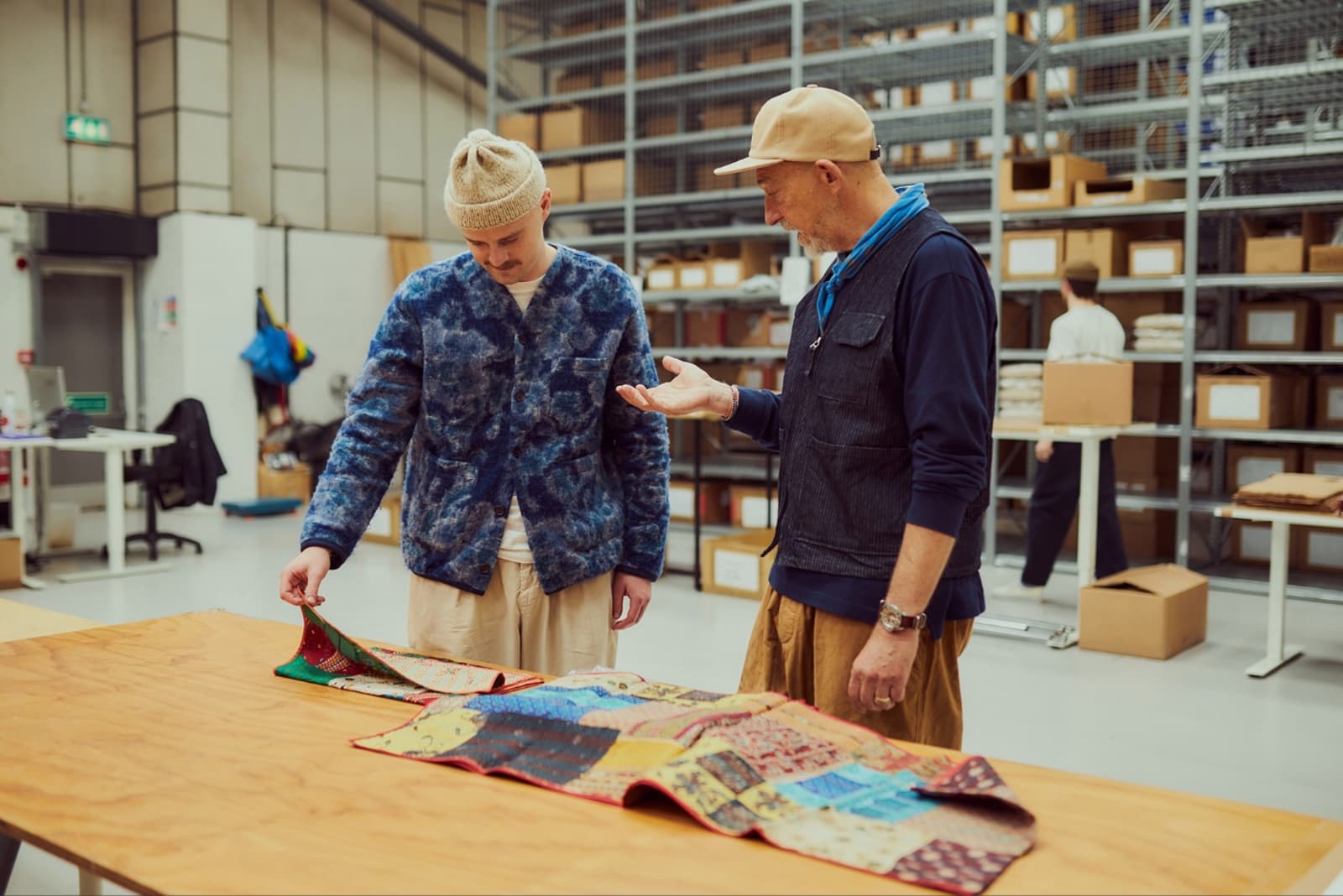
30 March 2026Teaming up with Barbour at their HQ in South Shields, END. invited Harlem-born multimedia artist Shaun Crawford to collaborate on Barbour's Solway Re-Loved project.
Born and raised on the rough and ready graffiti scene of New York City, Harlem-native Shaun Crawford is an artist, ink-maker, and creative storyteller like few others. Cutting his teeth immersed in the subculture throughout the ‘90s, Shaun’s creative practice has taken on a myriad of forms.
Now known for his bombastic style, Shaun blends painting, soft sculpture, drawing, embroidery and dyeing to great effect, harnessing the energy of graffiti, but recontextualising it through different mediums. Pairing vibrant colours, intricate textures and charismatic imagery that pays homage to the cultural fabric of the here and now, Shaun’s visual style breaks the mold in a way that instantly commands attention yet retains a sensibility that sees him pull from a variety of disparate influences. Placing emphasis on process and quality materials, Shaun’s dedication to craft has seen him continually evolve as an artist, with his outlook centred around experimentation, contorting the familiar with a distinct sense of humour and playfulness instilled in him from his time as a graffiti writer.
Partnering with END. and Barbour for their Solway Re-loved project, Shaun created his own bespoke 1 of 1 jacket bearing the hallmarks of his own creative practice and his personal sense of style. Utilising the Solway jacket as a blank canvas for self-expression, Shaun’s visual outlook transforms the traditional British outerwear garment into an authentic piece of his own – one that celebrates Barbour’s heritage, but contexutalises it through Shaun’s own experiences and passion for the brand.
Sitting down with Shaun following his three-day trip to Barbour’s HQ in the North East of England, we spoke about his creative practice, his first experiences with Barbour and the inspiration behind his truly inimitable Solway Jacket.


How did you initially get involved in making art?
Well, I've always been drawing since I was a little kid, and my mom used to sew and make all types of things around the house. And then my godmother, my auntie Barbara, she used to make custom African hats when I was a kid. Me and my sister would go to the shop and watch her work. She was really integral to me being an artist. She always supported me in being an artist. As I grew up and got older, she would always tell me about programs and grants and things like that that I could get. I never applied for any of them, but she was just always very adamant in telling me about that stuff, always encouraging me to make art. My whole family always was too. I was initially, really into graffiti. I still am. I still consider myself a graffiti writer. I don't write as much as I would like to, because I have a family and I can't go to jail for that shit, but that's my art form. That's the art form that I claim. If anybody ever asks me what kind of artist I am, I tell them I'm a graffiti artist. Because that's where I started and that's where my heart is at. Even when I was really young and I was getting in trouble for it, getting arrested, getting caught, getting into all types of stuff from writing graffiti, my family always encouraged me to make art. They’d say “Just don't get caught” or “stop writing in our building. Move it around, man.” And I mean encouraging me to the point of buying me spray paint, buying me markers, things that I would get caught using in the street. It was just never like, “you need to stop that.” It was always encouraged in me. I had a long time where I didn't make art for maybe eight years, I just didn't do anything. I would doodle a little bit on paper, but I was mostly just focused on getting a job and trying to be an adult. And then at one point, I would say maybe when I was 23/24, it came back. I just wanted to create and make things. I've just been constantly doing that. I've always just made something. Even when I wasn't making art, I would do little projects around the house. I would try to fix the tiles. Just doing all types of little crafty, artsy things. That's just always been a part of who I am. It's 10 years now that I've really decided to take it seriously and really push it and just try new things all the time. With Instagram, that really helped me get started on a professional level, honestly. I was just always putting my stuff out there. Even when it wasn't that good, I would just put it out there. I'd get a little reaction from it. It just encouraged me to do more and more and more. It's just gotten better as time goes on. I feel like every project I do is better than the last. Other people might not feel that way, but that's how I feel. It feels really good to get these things out.
What was the impetus that compelled you to take your art away from the streets and the graffiti context, and into the studio/gallery space?
Around 2004, 2005-ish, a lot of my friends, a lot of the younger guys that I knew that were writing graffiti, they all started getting into making t-shirts and working with brands. All the IRAK guys, those are my friends. They're all a little younger than me. Kunle, I knew SACE a little bit, I didn't know him that well, but I considered him a friend. My boy KS, King Solomon, those are really close friends of mine. I was watching them make money from this. I was like, “you can really make money?” At the time, I was working for a sourcing company. We used to source custom USB drives for pharmaceutical companies and all types of stuff. I was learning how to get these things, how to make things like that. I could make something custom; I just needed to spend a little money. At that time, I wasn't that confident in my artwork, so I started a small ink brand. It was called Do*Em*Dirty. I was always good at mixing inks and mixing chemicals to make a cool ink. I started with that, and then I designed the label for that, I found the bottles and the marker parts of it. I did really well with that, actually. That was my first little bit of success, working on my own and having my own business. You could say I was selling the art as well, because the label was stylized and everything. I never really did t-shirts, because I was afraid of putting out shirts and not selling them. The ink was already selling, so I was like, I don't need to do that. Within doing that, that also encouraged me to make more art and keep it pushing.
What was the moment that gave you the confidence to then start pursuing art more directly?
When I met my wife, before she was my wife, and we were just dating. Her dad is a professional artist and the first time she came to my house, I had all these little drawings on my walls and around my room. It was funny. She was saying, “yo, what are you doing!?” At that time, I was just partying. I wasn't doing anything. I wasn't taking anything seriously. I had my ink business, but I was ruining it because I was partying so much. I was letting it fall to the wayside because I was out every night going crazy. Any little money I made from that, I would just go out with it. I was paying my bills and stuff, but I wasn't really taking it seriously or pushing it the way that I should have. I remember the first time she came to my house and she saw my drawings on the wall. She said, “yo, what are you doing?” I said, “what do you mean?” She replied, “you could actually be doing something with this. I see things in galleries and in museums that's crap. This is better than a lot of the stuff that I see at those shows.” I took it really seriously because her dad has been an artist her whole life. That just really sparked it in me. I thought I really need to try to make something happen with this. My first workings in the art world at all, it's not even in the art world, it was more like craft work, was when I started working for Goyard. I got a job with Goyard painting for them. They trained me in France, and they actually taught me how to use a paintbrush. Before that, I worked with markers and spray paint. I would do some light little sculpture stuff here and there, but nothing serious. They really taught me how to use a paintbrush and also taught me a process. I never had any processes of painting or drawing. With graffiti, everything is quick, quick, quick. You do it now. You may take time to sketch a masterpiece or do something on paper in a book with markers. That's one thing, but you still even try to do that in a day. You don't give that three days, four days, a week, or even a month. With Goyard, the process of painting their bags or doing the marquage, as they call it, all of that takes three days. That taught me to slow down. It taught me, all right, you do one layer at a time and then do the touch-ups. I applied that to all my work. That's really helped me out. Sometimes, I'll have an idea, and I have no idea how to do it. I'm like, okay, if I at least sketch it or at least write down the idea, I can come back to it later and actually make it happen. That's really helped me out a lot.
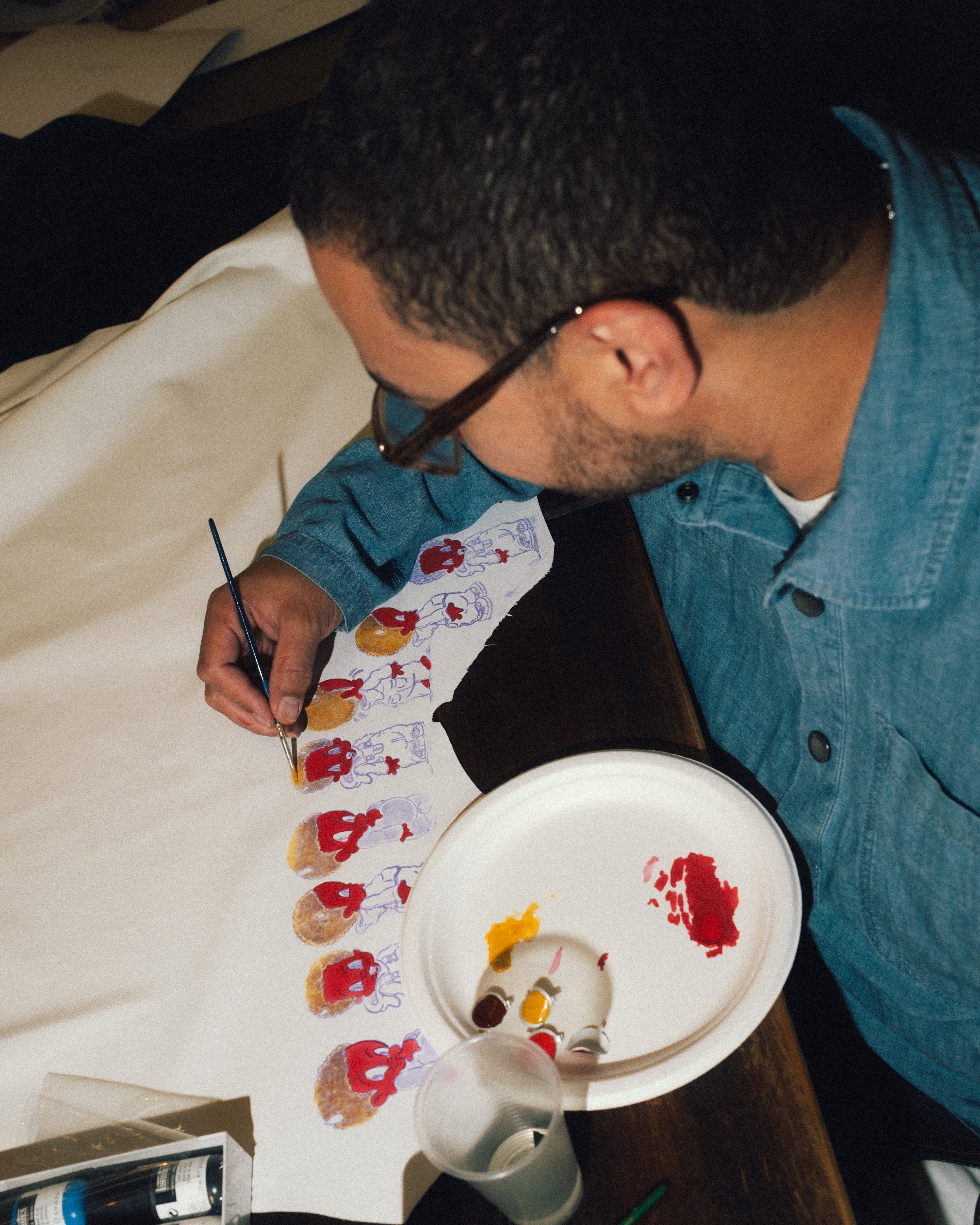
“I feel like every project I do is better than the last. Other people might not feel that way, but that’s how I feel.”
Your work draws from a variety of different cultural reference points – from graffiti to cartoons, and music subculture to skateboarding. What guides your creative process when you’re first conceptualising your work?
Honestly, I can be inspired by almost anything. Sometimes, just going out in the country inspires me. The sounds, the colours. I'm inspired by a lot of things. I try to learn something new every day. No matter what it is, it can be the smallest thing. You don't put sugar in this because of that. It doesn't matter what it is. I'm trying to learn a little something. I'm just inspired by so many things.
A huge thing that inspires me is clothing that I can't afford. I'll see some stuff that just looks really cool. When I was young, I used to be intimidated by that kind of stuff. I wouldn't even walk in certain stores. But now, let me just go in and see. I want to see why this costs so much, why it's so cool. What's the deal with it? Just touch it, smell it, experience it. A good example of that is the brand Kapital. I love Kapital. It's so cool. It's extreme Americana - really cool shit. Anytime I make any extra money, I'm going to go buy a pair of those jeans. I go into the store and I grab the jeans. I'm like, “I can fucking make these jeans.” Then I make a pair of jeans. It always happens! As I've gotten further along, because a lot of stuff, I always try to do it myself, but I've gotten better with delegating tasks to other people. I made friends with the guys at Arena Embroidery in New York. We made some hats together. Rocco, who owns that place, I love this guy so much. Not that I've worked with other embroidery places, but I've gotten things embroidered before. I give them a drawing and give them instructions. They won't really tell you if something doesn't work. They'll just do it on the piece and give it to you. It looks like shit. You're like, “why does this look so bad? My idea was so good. Why does this look like this?” With Rocco, he's helped me out so much. He'll tell you when something doesn't work, but then he'll give you a suggestion and give you a solution. We've worked really well together in the years that we've been doing things. I've been very lucky that I've been meeting other people that we do the same thing. I make it clear that I don't know what I'm doing. I come in and say, “look, I have no idea how to do this, but I have this idea. Can we work together on making it happen?” That's really helped me. Just going into things, wanting to do them, and acknowledging I don't know how to do it, and then giving it up to somebody else to help out. In that way, I've been working collaboratively with a lot of different people, and it's been working out really well.
I think a lot of people are quite scared to sometimes just admit that they don't know how to do something and ask for that help.
You know what's really funny? I have a lot of life experience. I've worked a lot of different places. At one point, I used to work at the Apple store. Part of their training was to not upsell people, and if you don't know something, just say you don't know. I've carried that with me ever since I've heard that. Why just talk out of your ass when you can be like, “hey, you know what? I really don't know, but let's Google it together and figure it out.” That's what I've been doing ever since. Even before that, working at the sourcing company taught me how to do research online. Working for Apple taught me to say I don't know. Now I'm trying to figure it out with someone else.


It’s evident that your work incorporates a lot of elements of craft, something that is often, undeservedly, separated from capital ‘A’ Art. How do you see the relationship between craft and artistry in relation to your work?
There is no difference. Craft is art. There are a lot of artists that don't paint their paintings. How are they an artist? Who are they to tell a craftsperson who puts their time, effort and skill into their work that they're not an artist? There are people, like conceptual artists, who just come up with the concept of this thing but do nothing themselves. They just hand it off to a bunch of other artists. Actual artists, craftspeople, those are the actual artists. In my opinion, that approach would make you a producer or a director. That's not necessarily an artist. But then who's to say that that's not an artist either? I don't know. I don't think that there's a difference. I try to make things, and I think that's what makes me an artist.
I never really trained as an artist. My training is just from writing graffiti. I went to art school in the eighth grade. I don't know how that translates in Europe. It was the first year of this school. I don't even know if it's still around. It was called the Art Institute and I was in the first class of this school. They did teach me a lot of things. They taught me how to sketch and all the basics. We didn't really learn painting and stuff. Everything else I learned on the street, or I just learned on my own. Honestly, too, YouTube tutorials, all that stuff. All that stuff is very helpful. You just have to find someone that you think is good that's doing that stuff.
Again, all of this just comes from my life experience and just trying to learn how to do things and learning how to do things in a different manner than most people do. I don't know. I don't want to say I have ADD, but I get bored really easily. Sometimes I get hyper fixated on things. When that happens, I just go in. It's the same thing with art. There will be times that I'll draw something, and I like the way it looks, but then when I paint it, it looks a little cooler. When I do it in embroidery, when I hand punch it, it looks way better. My art tends to work well for clothing, too. I've gotten more traction clothing-wise. I've had good shows and I've sold work, don't get me wrong, but I've gotten a lot of traction with fashion. My first show, my first real show, my first solo show, was in Nepenthes in New York. Originally, I was going to do paintings for that show. Then I thought, “you know what? I'm going to do all textile stuff.” They have such cool textiles in there. I ended up tie-dyeing rugs and doing a bunch of punch needle pieces. I made soft sculptures, and I showed a giant rug that I had made with my friend in Nepal. That went really well and helped me start my career in working with different brands.
As a longstanding brand with a distinctive legacy, everyone’s story with Barbour is different and singular. What was your first introduction to Barbour?
This is really funny. The first wax jacket I ever had was a Ralph Lauren jacket. It was a short, cropped jacket - brown. I had put so much of the wax on it that it looked like leather. I would just wear it all the time. I ended up trading it to a friend for a different jacket. Years later, I was watching Law & Order, and the DA, Jack McCoy, had on this wax cotton jacket. I immediately thought, “what is that jacket?” I was watching the episode and I was thinking, “damn, that jacket is mean.” The collar stood out to me and I was like, “damn, that's a really sick barn coat. What is that? What is that jacket?” I saw the zipper and then one day I saw the jacket on a rack and found out that it was Barbour. At that time, I was on the internet looking them up, finding them. I found a couple old ones on sale. I bought my first one. I bought a used one. I re-waxed it and everything. It's funny, I got to actually use the hot table here [at Barbour HQ] to wax the jacket with one of the guys over there. That was really fun, because the first time I did it, I was using cold wax, and it was so tough. I had to use the blow drier to get it to melt and be even. Anyway, I had that piece, loved that jacket, wore it to death. I think I sold it. I got another one. I got a brand new one from the Barbour store uptown. I had a goose down one that I really loved. I wore that jacket so much until I got too fat for it. I ended up selling that. This opportunity came up and I was like, yes, 100%. I want to work with Barbour, I’d love to make something with Barbour. I've got a ton of different ideas of things that we can do. We ended up settling on this one. I actually came here with an open mind and a few ideas that I had floating around my head. I combined three different things and we came up with something really, really cool. I'm so excited about this piece.
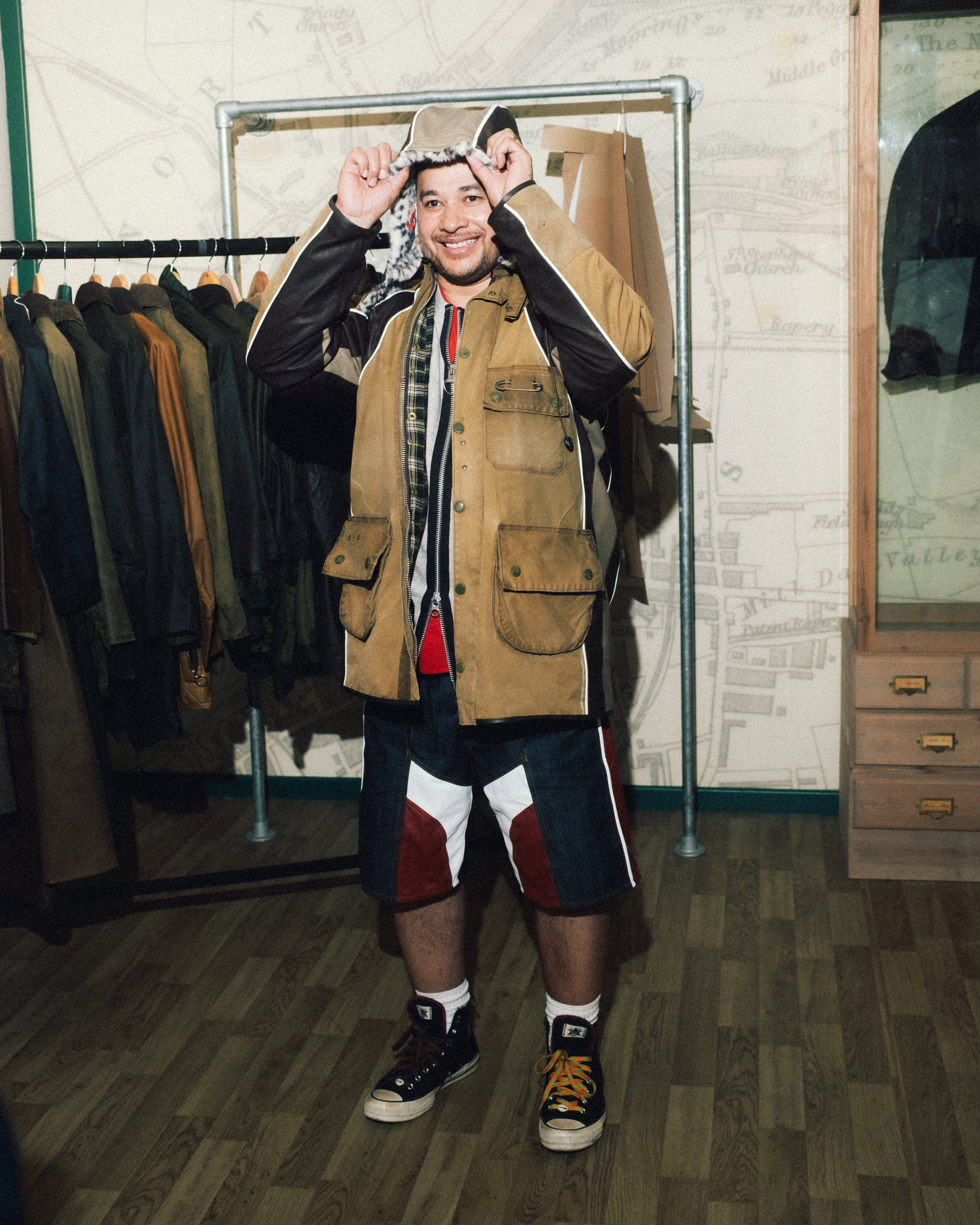
"This jacket is a combination of my understanding of UK styles. The Barbour jacket, which is very traditional, very UK, very European. Very cool jacket. I love that jacket. Then I was like, how can I make this Shaun? When I think of the UK, I also think of punk rock music. Another thing that comes up immediately is track jackets and track suits. So, I was thinking 'how can I combine those three things?' And we did it."
You’ve spent the past three days here in the UK, working at Barbour HQ. How has it been collaborating with Barbour?
Man, it's been fucking terrific. I've been having so much fun here. Just getting to see the archive pieces, the new pieces that they're working on, getting to see the actual workshop, what do you call that? The floor where they're sewing everything. I'm not using the right words, but just seeing all of it, smelling the wax, hearing the machines run, talking to everyone who works here in all the different departments. It's just really cool.
Gary and Mick have been amazing with helping me design this jacket and telling me what's possible and what we could do. All the ideas that I had have been possible when we worked them out. And then Darren machined it all together and it's just fucking beautiful. It's such a cool jacket. I'm really excited about this jacket because this is something that if I saw it on a rack, I'd be like, “I want that jacket, how do I get that jacket? Who can I call to get this jacket? Who's going to send me this jacket because I don't go shopping anymore.” Now that I've worked with all these brands, people send me a lot of things for free so I don't normally shop too much. Sometimes I have to because I can't wear all one brand all the time. So, I have to go buy things or I just make my own stuff.
What has inspired your specific take on the Solway jacket?
This jacket is a combination of my understanding of UK styles. The Barbour jacket, which is very traditional, very UK, very European. Very cool jacket. I love that jacket. Then I was like, how can I make this Shaun? When I think of the UK, I also think of punk rock music. Another thing that comes up immediately is track jackets and track suits. So, I was thinking “how can I combine those three things?” And we did it. We put the lines from the track jacket in leather onto the Solway to keep it classy. Originally, I was thinking maybe it would be even cool to do it with self-fabrics to do different colours of canvas on it. But I was thinking the leather would really make it pop. We did the faux ocelot collar on it. I thought that was a really good punk touch. The hood: really crazy. It's a leather hood with the ocelot and leather patches on the inside and we put eyelets across it so we could put big safety pins through the jacket. It's so fucking cool. It's so dope. I'm very excited about this jacket. I can't wait to wear it again. I think it's going to be almost finished when we come out of here. I wish I could wear it at home. But it's got to get displayed and everything so we can really celebrate it.
I wasn’t sure if it would work, but it totally does. I could see it in my head. I had photos of the Solway and I laid them out and I was drawing on top of it and dropping the different fabric swatches on it. I was thinking, “this is going to work. This is going to look really cool.” Especially getting it done here, where they repair and make the jackets, they can do it perfectly. I work with some really good people that do really good work and I think they could pull this off too but to actually have it done in the factory is sick. It's so cool.
Materials hold importance in your artistic practice, as they do within the world of Barbour. Why did you specifically want to incorporate the leather panels, faux ocelot fur and patches in the 1 of 1 piece you have created?
I have this waxed cotton Polo jacket. It's a shooting jacket and it has a big leather patch, like a shoulder patch and it also has elbow patches, and it has leather underneath the collar. I love that jacket so much. I thought that this could work so well on a Barbour. I've seen Barbour jackets with slight leather trims but to expand on it would be really cool just to add some inserts. I knew the jacket they had was small and I make everything for me. Every little piece of art that I do, all of it is for me, even if it's for someone else, it is for Shaun. I have to approve of it, I have to like it, I have to want it, for me to even put it out there. My whole thought was how can I make this jacket fit me, first of all, and how can I make it look good on me. These were all the ideas that came together and it all worked out perfectly.